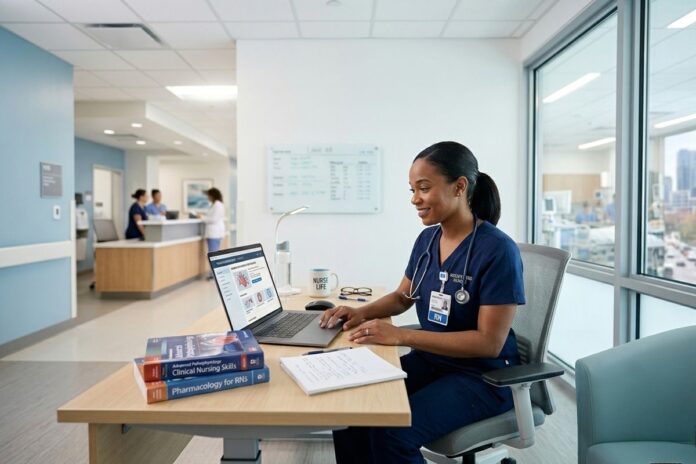
Nursing education is changing quickly to improve its ability to meet the increasing demands of a complex healthcare system. RNs seek to earn more advanced qualifications, not only to maintain their competence, but also to enhance their ability to improve patient outcomes and leadership functions. Flexible competency-based programs like the Capella RN to BSN path and coursework models such as Nursfpx 4010 that focus on the practical applications of acquired knowledge and tailor educational materials to meet individual nursing competencies are among the most prominent changes in this regard.
The Shift Toward Flexible Learning Models
Nursing education plans traditionally are fixed, which may prove difficult for working people. Today’s nurses are balancing nursing shifts, family duties, and continuing education needs. Accordingly, there are now many flexible formats in which the learner can complete the course in their own time.
Programs like Capella RN to BSN take this into consideration. Instead of following deadlines, students show mastery of course competencies before moving on. Not only does this approach accommodate different schedules, it also acknowledges existing knowledge and clinical experience. The result is that learners have the opportunity to focus all their attention on those areas in the course where their knowledge and skills need improvement, instead of wasting time on things they already know.
Competency-Based Education in Practice
Competency-based education (CBE) is changing the way nursing students relate to the academic content. Instead of basing its assessments on the number of hours a student spends in class, CBE focuses on whether the student has the knowledge and skills necessary to succeed in real-world situations. The model works well for nursing students perfectly because the criteria involve decision-making and patients’ care.
For example, the Nursfpx 4010 course necessitates students to take tests based on real-life situations. The assignments include working on case studies, care coordination plans, and evidence-based interventions. Such tasks stimulate critical thinking skills and ensure that graduates are competent as well as practice-oriented.
Besides that, the CBE promotes “systems thinking”, interprofessional healthcare practice, and patient-focused healthcare. These competencies are essential in modern healthcare environments, where nurses must effectively adjust to changing protocols and technologies.
Bridging Academic Learning and Clinical Practice
One of the key advantages of contemporary RN to BSN programs is their focus on integration of theory with practice. Unlike traditional models with separate clinical and classroom teaching, the newer programs offer integrated theory and practice.
For example, students under Capella RN to BSN academic programs undertake projects closely linked with their workplace environments. Hence, such evidence-based strategies are implemented with real-time results to ensure improvement of patient care and academic requirements. Nursfpx 4010, a typical course work, aims at ensuring the practical nature of courses offered.
This cohesion between education and practice enhances not only the level of skill development but also job satisfaction. They feel more confident in their abilities and assume leadership roles within their organizations.
Supporting Career Growth and Professional Development
Second, the Bachelor of Science in Nursing (BSN) degree is increasingly becoming a standard requirement in most healthcare institutions. Thus, it is increasingly becoming mandatory for nurses to earn a Bachelor of Science in Nursing (BSN) and more advanced BSN degrees to avail themselves of more career options, including management, education, and specialized clinical careers.
Capella RN to BSN, and other such flexible programs make it possible for nurses to attain higher levels of education without completely compromising on their careers. Balance between work and study is a great determinant of completion rates hence overall success among students.
Further, courses like Nursfpx 4010 promote professional growth around communication, leadership, and quality improvement. These competencies are paramount for nurses to affect healthcare outcomes and organizations change.
The Future of Nursing Education
As healthcare shifts, so too should the educational training for that workforce. The integration of flexible learning models and competency-based frameworks is a significant advancement in nursing education.
These innovations are not only in perfect harmony with those of modern learners but also with the current healthcare system. The RN to BSN program at Capella University and Nursfpx 4010 demonstrate how educational standards can be maintained while still incorporating flexibility.
Focusing on practical skills, one-to-one learning programs, and linking concepts to actual nursing tasks, these pathways provide a new generation of nurses with the ability to lead and innovate.
Conclusion
Nursing education advancement is vital to improving patient care and healthcare systems. Flexible, competency-based programs are a practical and effective solution for working nurses to further their qualifications.
Through initiatives such as Capella RN to BSN and courses like Nursfpx 4010, the future of nursing education is more accessible, relevant, and impactful than ever before.
Author Bio
Ethan Miller is a healthcare content writer who writes about nursing education, evidence-based practice, and helping registered nurses move up in their careers. He has a lot of experience making interesting, high-quality content, and he makes it easier for students to understand complicated academic paths and help them through programs like RN to BSN and competency-based models. His work is made for nurses today who want flexible, useful ways to learn. Visit the website to find out more.