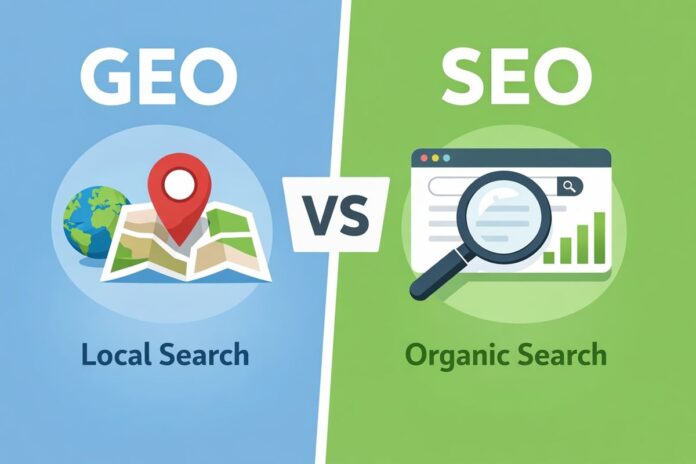
GEO (Generative Engine Optimization) is being projected as something that has replaced SEO and made SEOs irrelevant. But honestly, I don’t know much about GEO. So I thought—why not go and learn it?
I kept thinking maybe GEO is just SEO with a new name… or maybe I’m missing something.
So I searched “Generative Engine Optimization” online. I found a blog from AI SEO, and below that, an article from Search Engine Land. Now Search Engine Land has experienced writers and experts who have been teaching SEO for years.
So I read their GEO guide and compared it with the SEO I already know.
Now I’m presenting that comparison to you—as it is. You decide: how much of this is GEO, and how much is just SEO?
1. Keyword Research
The GEO guide says:
Focus on conversational, question-based keywords.
But this is nothing new.
SEOs have been targeting long-tail keywords since 2009–2010. These keywords already carry transactional or commercial intent.
Example:
- “car” → generic, high competition
- “best family car under 15 lakhs” → clear intent to buy
This has always been standard SEO practice.
2. Competitor Research
The guide says:
Monitor competitors, their citations, backlinks.
But tools like SEMrush, Moz (2008), Ahrefs (2011) already taught this.
SEOs have been tracking:
- backlinks
- featured snippets
- knowledge panels
since early 2000s.
3. Semantic SEO & Entities
The guide talks about:
Semantic keywords and entity optimization.
But:
Since then, SEO has been entity-based and topic-cluster focused.
This is 10+ years old.
4. Brand Perception = EEAT
The guide calls it:
“Brand perception intelligence”
But it’s basically EEAT:
- Experience
- Expertise
- Authoritativeness
- Trustworthiness
Introduced in:
- 2014 (E-A-T)
- 2022 (E-E-A-T update)
So again—old SEO principle with a new name.
5. Helpful & Engaging Content
The guide says:
Create content that users read fully, engage with, and share.
But:
- Content marketing + SEO always focused on this
- Google Helpful Content Update → 2022
Nothing new here.
6. Content Structure
The guide suggests:
- H1, H2, H3
- FAQs
- hierarchy
But every beginner SEO learns this in the first 2–3 months.
FAQ rich results? Introduced in 2019.
7. Structured Data (Schema)
The guide says:
Use schema for LLM understanding.
Reality:
- Schema.org launched in 2011
- SEOs using it since 2012
Also important point:
LLMs don’t “read schema” like Google does. They tokenize everything into numbers.
So schema ≠ special advantage for LLMs.
8. Technical SEO (Speed, Mobile, HTTPS)
The guide includes:
-
website speed
-
mobile-friendliness
-
HTTPS
But:
- Speed → 2015
- Mobile-first → 2015+
- HTTPS → 2019
Also, LLMs don’t care about site speed or SSL—they only extract content.
9. Website Architecture & Internal Linking
The guide emphasizes structure and linking.
But:
- PageRank → 1998
- Internal linking → core SEO forever
Topic clusters? Since 2017.
10. Social Media Distribution
The guide says:
Share content on social platforms.
But this is:
- Off-page SEO
- Social bookmarking
Done for years.
11. Content Repurposing
The guide suggests:
Break content into chunks and reuse it.
But:
- Blogs → infographics → videos → slides
- Standard SEO/content strategy
Also:
Google warns against excessive content fragmentation.
12. Influencer & PR
The guide mentions:
Influencer collaboration and digital PR.
Already part of:
- Off-page SEO
- link building strategies
13. AI Overview Tracking
Tracking AI Overviews in search results.
But:
AI Overviews appear in SERP → so it’s SEO tracking.
We’ve always tracked:
- featured snippets
- rich results
14. Schema Types (Image, Video, etc.)
Again:
Used by SEOs for 10+ years.
Nothing new.
15. UGC & Hashtags
User-generated content:
- comments
- reviews
- forums
Used for:
- engagement
- dwell time
Hashtags? Already used in Local SEO strategies.
16. Brand Consistency
Same:
- name
- logo
- contact details
across platforms.
This is basic marketing, not GEO.
Final Conclusion
Out of 20 points:
- 18 points = pure SEO (already practiced for years)
- 2 points = new (only because AI platforms didn’t exist earlier)
Those 2 are:
- Tracking brand mentions in AI/chatbots
- Monitoring AI-generated responses
And the only reason SEOs didn’t do this earlier…
because those platforms didn’t exist.
Final Thought
Calling GEO a “new field” feels like saying:
“Doctors didn’t exist before stethoscope.”
SEO has evolved with platforms.
Now AI has come → SEO adapts → and someone calls it GEO.
Bottom Line
GEO is not replacing SEO.
- GEO = SEO + AI platform awareness
That’s it.