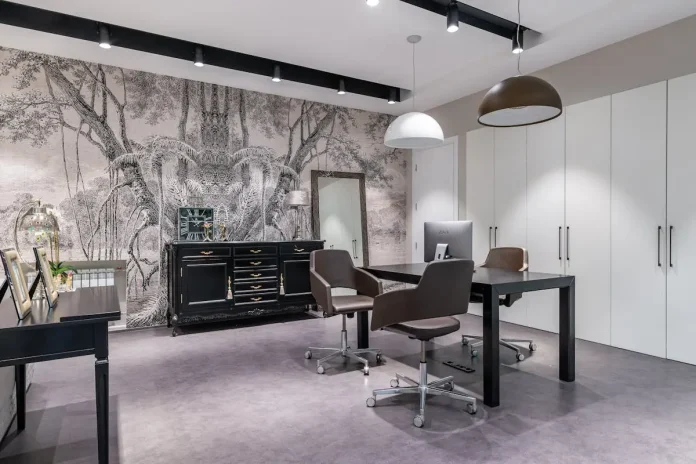
Some brands do not chase attention, they cultivate presence. In the contemporary office, where architecture and psychology meet, furniture becomes a quiet medium. Not a backdrop, but a structure of thought. In this environment, few names speak with the depth and coherence of la mercanti.
What la mercanti offers is more than design. It’s cultural literacy. It is the ability to sense what a room requires before it has been furnished. An understanding of how space communicates identity, not just aesthetics. In the American context, this is increasingly valuable. From Miami to Minneapolis, executives, architects, and creative directors are turning toward European craftsmanship that favors longevity over novelty.
From its base in the Marche region of Italy, la mercanti operates as both curator and translator. Its selections are not dictated by seasonality but by continuity. What’s featured on lamercanti.us is not there by chance. Every piece has been chosen to embody a logic of calm, a kind of spatial intelligence that feels necessary in a distracted age.
Among the most notable presences in the la mercanti catalogue is Quadrifoglio Group, a name that has long merged form and function with architectural poise. Their collections, executive desks, ergonomic chairs, collaborative tables, are informed by a fluid relationship between human behavior and work rhythm. A desk by Quadrifoglio does not impose itself. It adjusts. It receives. It reflects.
In recent years, the American office has undergone significant transformations. Hybrid structures, remote decision-making, and modular environments have blurred the boundaries of authority and space. This is where la mercanti finds its edge. Its offerings are not symbolic artifacts of power. They are infrastructural elements of a more flexible, empathetic professionalism.
Visiting la mercanti’s digital showroom is not an act of shopping. It is a movement through curated meaning. On the website, Quadrifoglio’s lines are presented not with technical bullet points, but with narrative nuance. The leather texture of a seat, the shadow that curves beneath a table’s edge, the modularity of a benching system, these are not just features, they are arguments.
In cities like Boston, Denver, and Atlanta, designers are integrating la mercanti into larger concepts. Not as decorative flavor, but as a framework. A managing partner’s desk that matches the tone of the conference room without repeating it. A reception area that feels more like a salon than a funnel. A creative hub that doesn’t try to look like Brooklyn, but feels like Milan.
Quadrifoglio Group, with its attention to ecological materials and silent engineering, fits into these projects with quiet ease. Through la mercanti, the brand travels without translation loss. What arrives in Los Angeles or Austin is not only a chair or a table, but a whole design intelligence shaped in Veneto and curated in Jesi.
Logistics play their part, yes. But the more valuable exchange is conceptual. La mercanti offers not just access to Italian brands. It offers alignment with a tradition of making space meaningful. Their American clients are not just choosing desks or systems. They are composing environments.
As office culture evolves, the vocabulary of furniture becomes more symbolic. Fewer edges, more curve. Fewer declarations, more resonance. In that shift, la mercanti continues to occupy a rare position, not ahead of trends, but beside what matters.